

The world woke up on February 28, 2026, to major news: the United States and Israel launched coordinated military strikes on Iran—a significant escalation that has transformed regional tensions into active conflict. The operation, called “Operation Epic Fury”, targeted Iranian military and political leadership, prompting immediate retaliation threats from Tehran and heightened geopolitical uncertainty across global financial markets.
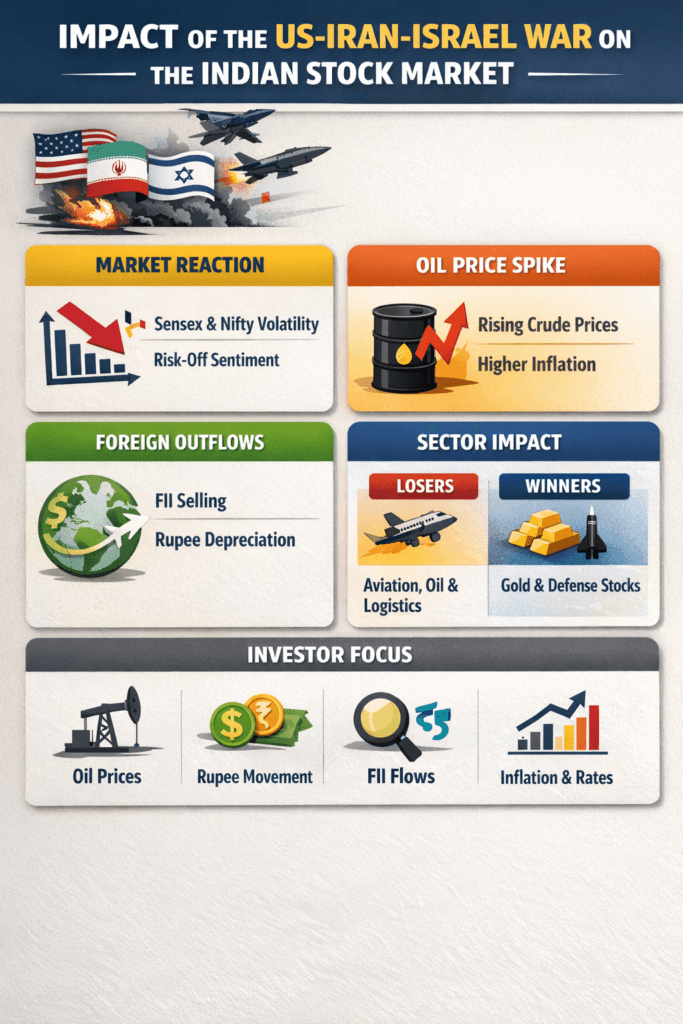
For investors in India, this is not just an overseas news flash it holds real implications for markets, inflation, commodities, currency and portfolio risk.
1. Geopolitical Shock Hits Sentiment Hard
Geopolitical shocks almost always trigger risk-off behavior in financial markets. The US-Iran-Israel conflict is no exception.
- Equity markets worldwide turned cautious within hours of the strikes.
- Analysts expect Indian benchmarks like the Sensex and Nifty to trade lower and exhibit broader volatility in early sessions, reflecting global risk aversion.
Why does this matter? When investors sense instability, they often shift capital from equities to safer assets—such as gold, government bonds or the US dollar—putting immediate downward pressure on stock indices.
2. Oil Prices: The Crude Reality Check
One of the clearest channels through which the conflict impacts India is oil markets.
The Middle East remains the heart of global energy supply, especially the Strait of Hormuz, a narrow shipping chokepoint through which a significant portion of global crude passes. India relies heavily on oil imports, with roughly 50% of its incoming crude transiting this route.
Conflict near such a strategic artery immediately lifts geopolitical risk premiums on oil:
- Brent crude prices have spiked, with major investment banks warning prices could reach near-term highs.
- Even talk of supply disruption triggers price jumps because oil markets price in risk over reality—anticipating what might happen rather than waiting for supply to actually be cut.
This has multiple cascading effects:
• Higher Inflationary Pressures
Oil price spikes feed directly into fuel costs, which ripple through transport, logistics and industrial activity—ultimately boosting headline inflation.
• Corporate Margins Under Strain
Sectors sensitive to fuel costs—like aviation, shipping, paints, tyres and logistics—may see margin squeezes. Historically, higher crude has weighed on these stocks and dampened market breadth.
3. Foreign Flows & Currency Volatility
The Indian stock market is influenced by global portfolio flows—especially foreign institutional investment (FII).
- In uncertain climates, foreign investors often reduce exposure to riskier markets like India’s, reallocating funds to safer havens.
- This can exert selling pressure on Indian equities, especially if the conflict broadens.
At the same time, currency weakness is a predictable reaction. In past Middle East escalations:
- The Indian Rupee weakened noticeably against the US dollar, as dollar demand surged and risk appetite declined.
A weaker rupee adds to inflationary pressure by making imports (especially oil) more expensive and dampens the returns of foreign-invested assets when converted back to US dollars.
4. Sectoral Impact: Winners and Losers
Not all sectors behave the same in crisis periods. Based on recent market data and historical trends:
Potential Underperformers
- Aviation and logistics – fuel cost spikes can hit profitability.
- Oil-dependent sectors (paints, tyres, plastics) – cost pressures often translate to lower earnings.
- Banking & financials – fall in overall market sentiment can widen credit spreads.
Safe Havens
- Gold and precious metals – typically trade higher as investors seek safe assets.
- Defense and energy infrastructure – may rally amid geopolitical premiums and higher security spending.
5. Long-Term Perspective: Not All Doom and Gloom
While the immediate reaction is jittery, investors should bear in mind:
- Markets often price in uncertainty before events unfold—meaning some of the downside may already be reflected in current prices.
- If conflict remains contained and does not disrupt energy supply long term, markets can recover quickly as sentiment normalizes.
- Strategic assets and fundamentally strong businesses tend to outperform over multi-year cycles.
Conclusion: What Should Indian Investors Watch
The US-Iran-Israel conflict has sent shockwaves through financial markets, and India is not immune.
To navigate this environment, investors should monitor:
- Crude oil price trends and supply disruptions
- Foreign portfolio flows
- Rupee exchange rate movements
- Central bank policy on inflation and interest rates
- Sector-specific earnings reports
Uncertainty is the enemy of short-term markets—but an opportunity for long-term investors who stay disciplined and informed. Stay Updated with us at ipogreymarket.in